Friday, July 15, 2011
NRHP Nomination
Well, we have made it to the second round of edits on the National Register Nomination for the Whitaker-Motlow House. Things are looking good! The Historical Commission will be getting back to me on further edits, and the review board will meet in September...keep your fingers crossed that we make it in!!!

Monday, April 18, 2011
Whitaker House Nomination
As the process moves forward...
the first draft of the National Register of Historic Places nomination for the Newton Whitaker House is due at the end of May!! Whew! Wish me luck, people!!
J
the first draft of the National Register of Historic Places nomination for the Newton Whitaker House is due at the end of May!! Whew! Wish me luck, people!!
J
Monday, April 11, 2011
The Newton Whitaker House, cont.
 |
| Bob Motlow surveys tornado damage |
In 1909 a devastating tornado struck the Mulberry area, and according to the local newspaper Bob suffered the greatest property damage in the area. As is seen in these photos, nearly 2/3 of the top story of the Newton Whitaker house was ripped away, leaving the once beautiful home almost unrecognizable.
 |
| Another shot of tornado damage |
Fortunately, though, Mr. Motlow was a rather wealthy man. As such, he was able to have the house rebuilt exactly as it was before. According to family history, Mr. Motlow hired a crew from Nashville and had them camp on the premises until the house was completely rebuilt. It may seem far-fetched that a house that had sustained such severe damage could be salvaged, but I assure it is true. To this day, the only obvious signs of change are noticed in the variances of brick color on the back portions of the house (as is seen below).
 |
| brick variation |
Fortunately, for those of us interested in such things, there are some surviving photos from before and after the tornado to give us some great examples of what the earliest versions of the house looked like.
 |
| Newton Whitaker House in 1905. Note the taller chimneys before the tornado. |
 |
Whitaker House c. 1940s or 1950s. |
The Whitaker House has undergone extensive restoration and preservation since the 1980s. In the next post, I will share with readers some photos and descriptions of what such a project requires.
Monday, March 21, 2011
The Newton Whitaker House, Mulberry, TN
In December 2010, I presented my senior paper on the Newton Whitaker House, so bear with me as this topic may take several entries to complete. Newton Whitaker, born in Lincoln County in 1816, was the youngest son of John Whitaker and his second wife Nancy Guess. When John died in 1837, he left all nine of his children a modest monetary inheritance, as well as other personal items. At the time of his death, John remained in possession of large land holdings; however, he did not bequeath this land to his children. The reason for this is quite simple: his land was intended to be sold off (except the land upon which his house stood) to repay debts. Nonetheless, Newton purchased 213 acres from his father's estate. It was here that Newton built his beautiful home. Interestingly, the placement of John, Newton, and Mark Whitaker's houses made a large triangle, and were located quite closely to one another. These houses also very likely closely resembled each other in style and appearance. Newton's house is the only one that remains in its original style. As mentioned earlier, John's house burned after the Civil War and was replaced with a wooden structure that likely resembles the original house, but varies somewhat. Mark (John's brother) built a brick Neocolonial/Greek Revival style house; however, a tornado in the 1950s tore away the second story, which was never rebuilt. The house is still inhabited, only now it stands as a one story house. Newton's house underwent serious tragedy as well, but that is a story for a little later on.
For now, we will focus on the early history of the house and it's builder. Newton was a farmer, and for the most part his land produced wheat and corn. Operations were rather small, and he possessed at most seven slaves at one time. In addition to his farming activities, Newton was a business and civic-minded man. He was a member of the Mulberry chapter of the Free Masons, served as a delegate to the Whig Party in 1852, served on the board for the Central Union Railroad, and helped establish the Bank of Shelbyville. His house shows his economic and social standings very well, in terms of architectural styles. It is a blend of the Greek Revival and Italianate styles and was constructed around 1850. The large front pediment, wide cornice line, and white columns are typical indicators of the Greek Revival. However, the brackets located under the cornice line are more indicative of the Italianate design. Nonetheless, this house is rather high style for a provincial estate. But, it is a far cry from the great mansions of the time found in places like Columbia and Nashville. The use of the I-house design is one example of where this stylistically academic house meets the vernacular. Moreover, the use of square columns rather than round exemplifies the need to "cut corners" and save on construction expenses. Regardless of the intermingling of styles, this house is an important element in understanding the middle class in early America.
Currently, the owner of the house and myself are working to have the house placed on the National Register of Historic Places. After submitting a preliminary nomination to the Tennessee Historical Commission, we were told the house looks promising for a full nomination. Some of the Historical Commission staff came to Mulberry on March 18 and visually inspected the house. We now have the go-ahead to complete the full nomination!
For now, we will focus on the early history of the house and it's builder. Newton was a farmer, and for the most part his land produced wheat and corn. Operations were rather small, and he possessed at most seven slaves at one time. In addition to his farming activities, Newton was a business and civic-minded man. He was a member of the Mulberry chapter of the Free Masons, served as a delegate to the Whig Party in 1852, served on the board for the Central Union Railroad, and helped establish the Bank of Shelbyville. His house shows his economic and social standings very well, in terms of architectural styles. It is a blend of the Greek Revival and Italianate styles and was constructed around 1850. The large front pediment, wide cornice line, and white columns are typical indicators of the Greek Revival. However, the brackets located under the cornice line are more indicative of the Italianate design. Nonetheless, this house is rather high style for a provincial estate. But, it is a far cry from the great mansions of the time found in places like Columbia and Nashville. The use of the I-house design is one example of where this stylistically academic house meets the vernacular. Moreover, the use of square columns rather than round exemplifies the need to "cut corners" and save on construction expenses. Regardless of the intermingling of styles, this house is an important element in understanding the middle class in early America.
 |
| Newton Whitaker House, c. 1850 |
Tuesday, March 1, 2011
In Memory of Jaleya..Always Loved, Never Forgotten
Dear Jaleya,
I have started to write this so many times, but the words wouldn't come out right. Today has been excruciatingly difficult though, and I no longer care how the words flow. I needed to do this.
 Since we lost you my mind has continuously raced. Thoughts of old times and memories from long ago have flooded my mind, and this knot in my stomach just won't let up. Even now as I write this, the tears keep coming. I think of geometry class and the notes you passed me every day, the talks we had and the laughs we shared. I also think about what you wrote me in my yearbook, song lyrics. It drives me crazy that I cannot remember the song and I hate that I don't have any of those things here with me. They are stored away for safe keeping in New Mexico, but I would give anything to be able to read them again. I know we didn't stay in as close of contact as we used to, and it brings me such regret. I know we have talked, but now it seems like it was nowhere near enough.
Your memorial service was beautiful, and I could feel you there with us throughout. We miss you so much, and you affected so many people in such positive ways that you may have never known. I love you and your family like my own, and I don't know how they are making it through their days without you. But, I promise to try to do anything I can to help them. Honestly, the only time I have felt even remotely ok was when we were all together this weekend. You brought us together in a very special way, and for that I truly thank you. After the service, there was a lot of talk amongst us (and you know who I mean) about taking things for granted and spending time with the ones we truly love. Promises were made, and I truly believe they will be kept.
I know you left us too soon, but from our loss has come much inspiration and an outpouring of love. You would be so proud. In the spirit of trying to look on the bright side, those are the things your life and memory have accomplished. In life, you have always inspired me to be a better person and to smile...your smile, that is one of the things I miss the most. They say that only time can heal the pain, but at this point this is still to be determined. I know my heart will always ache when I think of you. And, I am pretty sure that I am going to drive A.J. crazy with all my texting. But, on days like today, the really really hard days, the only way I feel like I can make it through is to know that he is ok and to tell him I love him.
You will always be special, and I think I speak for us all in your extended family when I say that you will ALWAYS hold a very special place in our hearts...Always. If there was anything I could do to bring you back and make everyone's pain go away, you know that I would. I love you, Jaleya, and I wish you peace.
I have started to write this so many times, but the words wouldn't come out right. Today has been excruciatingly difficult though, and I no longer care how the words flow. I needed to do this.

Your memorial service was beautiful, and I could feel you there with us throughout. We miss you so much, and you affected so many people in such positive ways that you may have never known. I love you and your family like my own, and I don't know how they are making it through their days without you. But, I promise to try to do anything I can to help them. Honestly, the only time I have felt even remotely ok was when we were all together this weekend. You brought us together in a very special way, and for that I truly thank you. After the service, there was a lot of talk amongst us (and you know who I mean) about taking things for granted and spending time with the ones we truly love. Promises were made, and I truly believe they will be kept.
I know you left us too soon, but from our loss has come much inspiration and an outpouring of love. You would be so proud. In the spirit of trying to look on the bright side, those are the things your life and memory have accomplished. In life, you have always inspired me to be a better person and to smile...your smile, that is one of the things I miss the most. They say that only time can heal the pain, but at this point this is still to be determined. I know my heart will always ache when I think of you. And, I am pretty sure that I am going to drive A.J. crazy with all my texting. But, on days like today, the really really hard days, the only way I feel like I can make it through is to know that he is ok and to tell him I love him.
You will always be special, and I think I speak for us all in your extended family when I say that you will ALWAYS hold a very special place in our hearts...Always. If there was anything I could do to bring you back and make everyone's pain go away, you know that I would. I love you, Jaleya, and I wish you peace.
Saturday, February 5, 2011
Book Proposal Accepted
I found out yesterday that Arcadia Publishing as accepted my book proposal, and Lynchburg is slated to be released in the summer of 2012. The book will tell the history of Lynchburg through over 200 historic photographs. There is still much work to be done, but I am getting there step-by-step. If anyone knows of any historic photos that they wouldn't mind sharing for publication, please let me know! The images will be scanned and returned to you pronto! Thank you to everyone who has been keeping up with the progress of my new venture, and as promised, I will keep you posted!
Ball Fork Baptist/Mulberry Baptist Church
 |
| Mulberry Baptist Church c. 1840 |
John Whitaker was reportedly a deeply religious man, and when he arrived in Mulberry he held church services in his home until a proper worship house could be built. In 1813, John donated an acre of land for such a structure to be built. Named the Ball Fork Baptist Church, the building stood where the Mulberry Cemetery still exists. The church immediately became an important part of the community, and remains so even today. The original wooden frame church burned at some point before 1840, and a second brick church was built. However, by the point the church was relocated to its current position on the Mulberry "square." As of yet, I have found no photos of the original church, but pictured here is the second edition. When the congregation decided to move the church, they decided not to rebuild in its original location. Instead, the church was moved to the square and renamed the Mulberry Baptist Church. The reason for this move is a likely result of the booming growth of the Mulberry community during the 1830s. Around that time, the Mulberry Male and Female Academy was constructed, and is said to have been one of the finest schools in Lincoln County. Following on the heels of the Academy, many businesses sprang up as well as several other churches. During this era, the 1840s, Mulberry was home to a blacksmith, a cabinet maker, a restaurant, a post office, several general stores (possibly as many as five), a Methodist Church, a Christian Church, a Cumberland Presbyterian, an undertaker, a bank, as well as several others. What is important to remember is that the bulk of these establishments were only built after the construction of the school and the relocation of the Baptist Church.
After the Baptist Church was rebuilt, it burned yet again at some point during the ladder part of the century, and was yet again replaced by another structure. Judging by the Gothic Revival influences of the building, it was probably built between 1850 and 1880. This church still stands today; however, some minor changes have been made over the years.
The Mulberry Baptist Church, as you can see, has long played an important role in the community. For me personally, the architectural details of the 1840s version of the church proved pivotal in my attempt to prove the construction date of the house I was primarily writing of (which will be discussed in a later post). When growing up here, I never cared about the historic churches and homes located here. But now, research has given me a reason to admire them and to share my findings with others. Frankly, I think we here in Mulberry are incredibly fortunate to have so many relics of the historical record standing right here in our back yards.
 |
| Mulberry Baptist Church, 2010 |
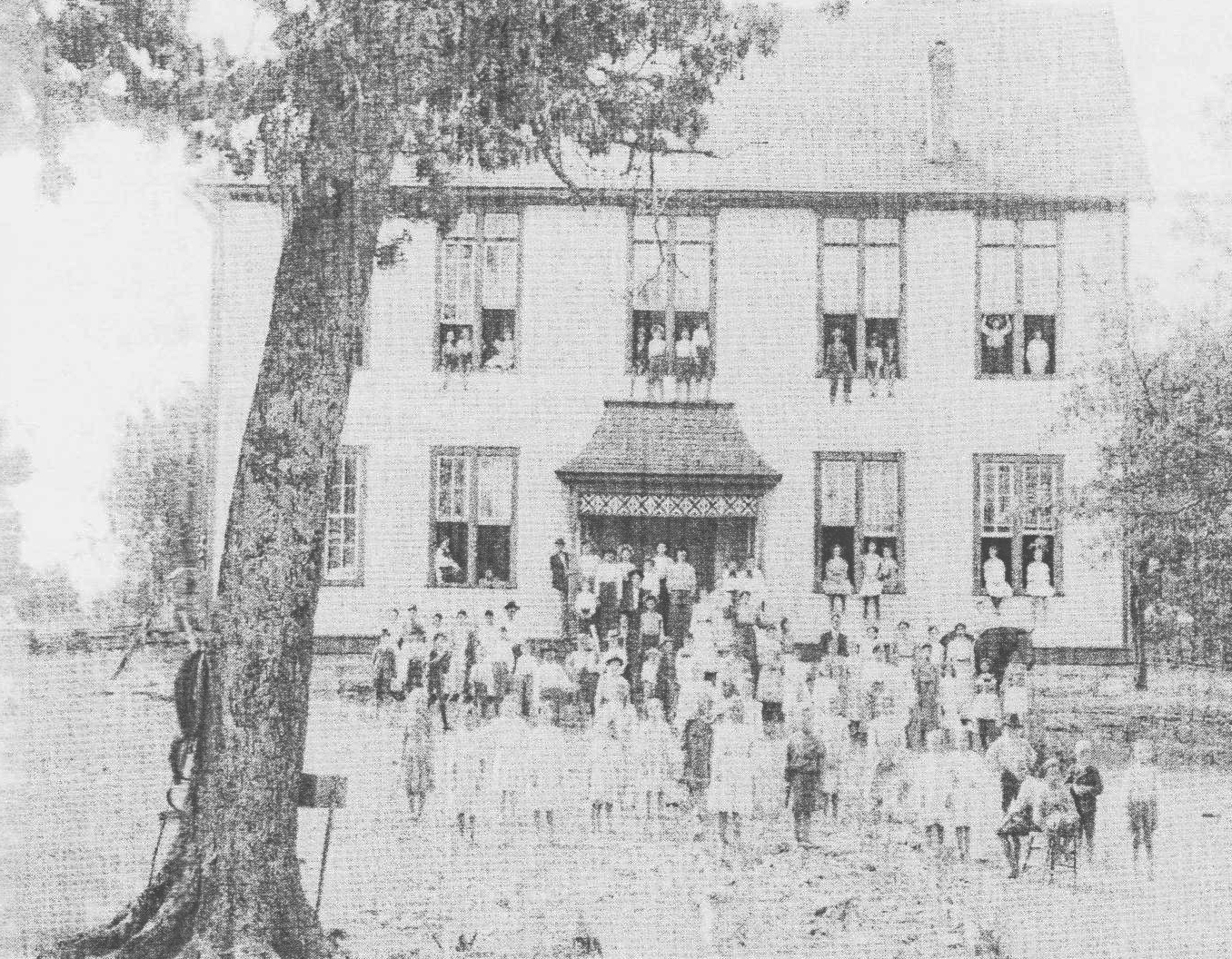 |
| Mulberry School, 19th century (exact date unknown) |
Subscribe to:
Posts (Atom)